What is Maternal Gatekeeping and Why Does It Happen?


Today’s post may feel mainly like a rant. But it has a purpose. It’s to show you the contradictions that exist to put pressure on women. When we see such contradictions, we are better equipped to not allow them to control us.
But I’m getting ahead of myself. Let me introduce today’s concept before I get into rant mode.
There is a technical term that describes women’s micromanagement of their male partners. It’s called “Maternal Gatekeeping”. Most specifically, it’s used in relation to parenting, although the term has been getting blurred into a usage that covers household tasks in general.
The idea is that women who engage in maternal gatekeeping either refuse to hand off tasks to men, or if they do hand them off, they only really do a pseudo-handoff, where they still hover, monitor, and criticize. Why would that be, people ask?
It does seem that some people are curious about the phenomenon. There is a research paper that describes a study of the characteristics of mothers to see if they could predict whether a woman would engage in maternal gatekeeping. And it’s not the only one.
Then a cursory web search will bring up some articles about it, all of them fairly similar in tone and content.
For example, there is an article from Motherly on the topic of maternal gatekeeping:
“We may think that we are in a progressive relationship until it hits us that we don’t believe our partner can dress our children or decorate a Christmas tree ‘right,’” says psychotherapist Erin Barbossa, LMSW. “It’s one thing to decide that your values inform you that you are the one in the home who will choose the outfits and decorate for the holidays, it’s another thing to do it because you’re unconsciously trying to create perfection and control the outcome.”
And there is an article from Fatherly on the topic of maternal gatekeeping:
“… gatekeepers are not primarily driven by a belief that women should manage childcare, but rather by perfectionism when it comes to parenting.
“It’s this deadly combination where the mother has really, really high standards,” (Schoppe-Sullivan, a professor of human sciences at Ohio State University)… “She thinks she’s a really good parent, but she’s maybe not so sure about the dad.”
And we even have an article on the topic of maternal gatekeeping, on CNN:
“Women don’t just want men to do more housework and child care because such labor can be tedious and exhausting; they want it because men not doing it is hurting women professionally. Though the fix here clearly involves dads doing more at home, men, even the lazy and obtuse ones, aren’t solely to blame for a lack of progress. Many moms – often unintentionally, sometimes unconsciously – stand in the way of progress.
Psychologists refer to this phenomenon as “maternal gatekeeping,” when moms control dads’ household responsibilities and/or interactions with their children.“
So, to recap. We’re told that the way to manage the workload that comes with a household and kids is to accept help. And, if our spouse doesn’t do things right (I mean, if the spouse doesn’t do things exactly how we would), it’s very, very important to not hover, or criticize, or complain.
If these articles are to be believed, women are frequently control freaks. We can’t stand it when someone else washes the plates before the cups. We grow spines when the black underwear is washed together with the white socks. We throw fits when the man of the house only half-vacuums a space and calls it done. We need to chill out, let go, and stop policing everyone around us.
…Okay, I’ll bring in an interlude in an attempt to reassure you all that I’m reasonable. Does anybody like being micromanaged, criticized, and complained at? Not me. So, of course, we shouldn’t inflict that on anybody else. All agreed? Okay. I’ll continue, and now I’ll get into the rant part of this post …
While everybody on the internet is busy trying to figure out what kind of woman engages in such a controlling activity, I’d like to sit off to side here, with you, my readers, and ask a somewhat different question:
What kind of situation is it that keeps continually coming up, which suggests to women that maternal gatekeeping is even necessary in the first place?
That’s right, instead of assuming that women are control freaks—even though no doubt some of us are—maybe it’s actually not strictly necessary to assume that this problem is all about the women?
Could it be that people, such as women, do things for a reason? Maybe if so many of us are engaging in such similar behaviors, there is a reason beyond us that makes sense of these behaviors?
Disclaimer: I’m not a researcher in this area. But heck, I’ve lived the problem, and that counts for something. So, I will happily tell you my take on why maternal gatekeeping comes about.
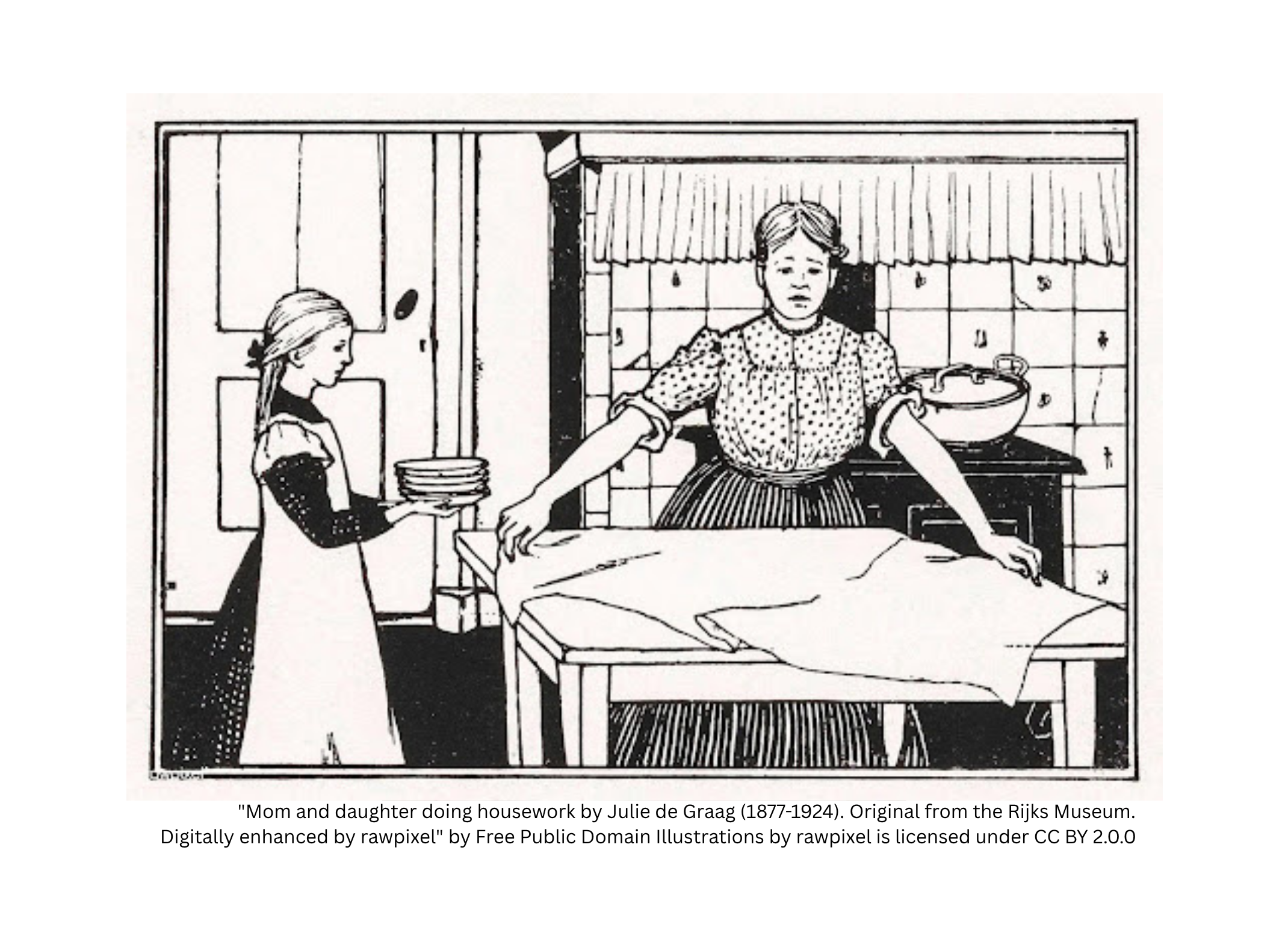
We are all familiar with the notion that if a home is messy, people wonder what the lady of the house was thinking to allow it to get into that state. So of course, this motivates us to work hard to keep our homes and kids tidy.
Who is likely to get blamed if the extended family doesn’t receive holiday cards and birthday cards at all the expected times? Yes, that would be the lady of the house. And then I wonder how it is that I worry about leaving people’s birthdays unacknowledged while my husband stares at me blankly and silently asks himself why that could possibly be so important.
So why do we police everyone around us? Because we know perfectly well that when the dad dresses the kids in mismatched clothes, everyone will wonder what on earth the mom was thinking.
When a mother-in-law surveys a half-vacuumed room, she won’t turn around to her son and ask him what he was thinking; if she turns up her nose at anybody it’ll be at you. That’s right, we know perfectly well the blame will come back to us.
We police everyone around us because we know the blame will come back to us.
Put your hand up if you’ve mastered the art of not caring about how a task is done if you’re guaranteed to be blamed for how that task is done. Anyone? Not me. The circularity here is ridiculous. We are the ones who will be blamed for the traditionally female tasks being done badly, even if we’re not the ones who actually performed them. But if we hand the tasks off and want the tasks to be done properly, we get told it’s our fault for being control freaks.
It’s an incredibly convenient set of arguments.
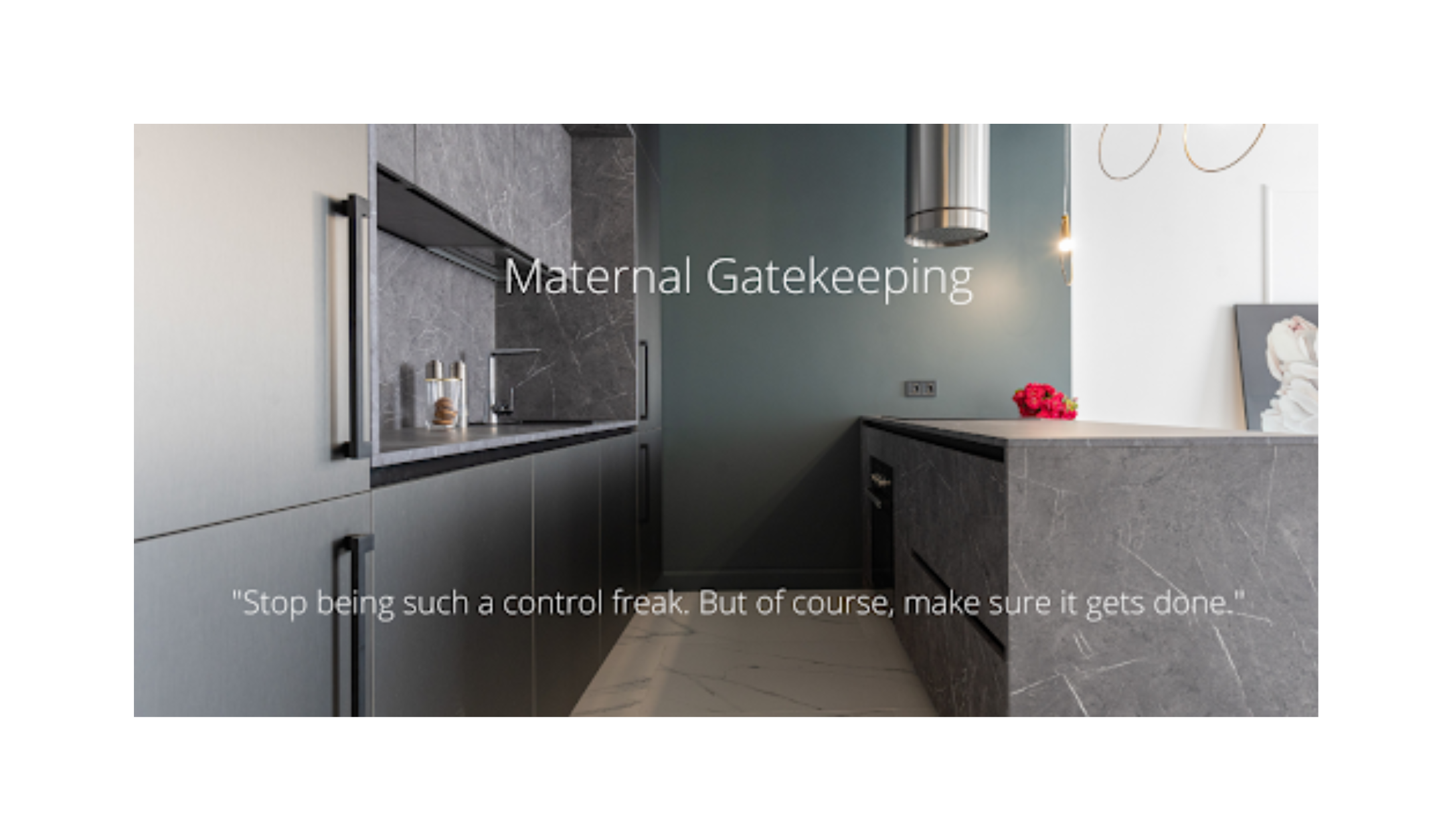
If we want this circular reasoning to stop controlling our lives, there is only one path forward. It is to stop living in fear of what other people think. Unfortunately, this is precisely the hard part.
Before we achieve that lovely state of not caring, there is a reasonable chance that we will continue to experience frustration, at least sometimes.
Are we stuck? No. We may feel frustrated, but we still have options for how we respond.
To start with, it will help us and other people around us if we are willing to talk about this whole problem instead of quietly attempting to satisfy such contradictory expectations. As long as the problem remains out of sight, unchallenged, the more likely people will be to perpetuate it. That’s one of the reasons I wrote this article. You don’t have to do anything systematic or planned to contribute to giving voice to this problem. But when you notice frustrating things like this, you can give yourself permission to give voice to what it is you’re observing. Long-term, we would expect that the less hidden this problem is, the less it can sneakily grow and multiply.
Short-term, for your day-to-day survival, here is the important thing you need to do: Surround yourself with the message that not controlling how well these tasks get done is okay. Any written material or podcast that reassures you of this, read or listen to more than once. If you have friends who are willing to reassure you about this, let them do so. You need this to counteract all the blame out there.
On a meta level, you can start by repeating to yourself the message from this article, which you are reading right now, that Maternal gatekeeping is not actually something women came up with. So you can stop blaming yourself when you find yourself doing it. Sure, you’d like to rise above this behavior. But you are not the cause of this problem.
When we think about it, nobody is forcing us to engage in maternal gatekeeping. It all comes down to the stress we feel when the blaming hits. Sometimes, we don’t even need other people to hit us with blame. We anticipate blame from others, or we just hear it inside our heads before it even happens.
It’s a pity that pushing back on this problem comes back to us. It would be so much easier if we could convince everyone else to be reasonable and stop blaming us in the first place. But I don’t think that is happening. Blaming women isn’t going to go away just because we plead for it to go away. The only way things are getting better is if we can get ourselves out from underneath that blame and go on with living our lives the way they should be lived. Even if we only succeed at it occasionally, it counts as progress.
So that’s why I’m saying: we need to counteract those blaming voices. Any message that tells us it’s okay to let the tasks go is a message that will send our brain in a different direction than the usual blaming messages. Anything we do to repeatedly put our brains on a path of less self-blame will help us. It will help us be less affected by blaming messages and more confident in taking charge of our lives. That way, we control our lives rather than the tasks controlling us.
You can’t control what other people think. Some people will persist with contradictory assumptions. Some people will even persist with it upon being shown that their assumptions are contradictory. But, once you see how contradictory these assumptions are, you are better armed for actually saying so to people—or not—as you see fit.
Your responses can include the following:
- You can be very direct about it, such as pointing out to the person that they are contradicting themselves.
- You can tell your friends if you think they’re getting trapped by this. Even just naming the problem and talking about it reduces its power over time.
- You can nicely explain to your mother-in-law how re-doing a task that your family members did would be invalidating to them, and you’re just too kind for that.
- You can say, “You’re blaming the wrong person!”. I like this one because it’s short and does not involve me engaging in long explanations. After all, explanations require effort as well.
- Or you can internally roll your eyes, get on with your life, and vent to a sympathetic friend later.
Contradictory assumptions about women will not go away overnight. Still, with enough women getting annoyed and not putting up with things, our culture has gradually changed over time. The progress may not be as fast as we want, but the less we accept ridiculous assumptions, the less those assumptions will eventually be made.
Get the Free Decluttering Guide
A radical approach to reclaiming your time and space. Free for newsletter subscribers.
Download the Free Guide →