The Science of KonMari: The Home That Tidies Itself

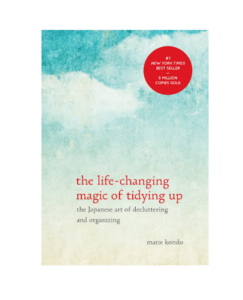
This is not a blog about tidying, but if a tidying method works particularly well, I suggest we take notice. Ever since starting to use the KonMari method on my stuff, my stuff has pretty much kept itself tidy. In fact, it’s so much easier to keep it tidy than let it be messy, that it feels like my stuff tidies itself. And no, it’s not magic. Although, Marie Kondo does actually call it magic, since of course, the book that describes this method is titled The Life-Changing Magic of Tidying Up.
(Note: I am not being paid by Ms. Kondo or anyone for what I’m saying here. I have no idea what Ms. Kondo would think of my analysis. 😊 Next question: You might wonder why I advocate for Marie Kondo’s framework when I have another method I teach as well. The truth is, different methods serve different needs. Personal systems aren’t exclusive—your preference can shift over time, and there is immense value in having more than one tool in your toolkit.)
You might think it’s all an illusion, that in fact, a whole lot of daily work goes into this. After all, hasn’t Marie Kondo herself admitted that her own home is messy now that she has kids? It seems to me that at least some people have used this as an excuse to throw the entire KonMari method (and any attempts at tidying) out the window. I don’t agree.
I’m going to make a claim. I suspect that Marie Kondo’s kids, just like anyone’s, move a lot of things out of their places and maybe, just maybe, don’t always put them back. And I agree with her that spending time with your family is, in the larger scheme of things, more important than putting those things back in their places. But that’s the whole point; tidying should be done to the extent that it makes your life better, not for its own sake. Everything about the KonMari method of tidying, or any method of tidying, should be applied in a way that improves your actual life, not a hypothetical one.
Most likely, a science teacher has told you at some point that all things tend towards disorder the more time passes. We’ve all experienced this to be true of our stuff! It seems that as soon as we look away for one moment, it becomes one big amorphous mess.
But I’ve found an exception to this. Namely, the stuff that I have taken the time to tidy via the KonMari method. Between that stuff versus the other stuff in my house, there is literally a distinct difference in how that stuff behaves.
For this stuff, I put it away without even thinking. I don’t have to push myself to put things away, it’s like the items pull at *me* to get put away. And putting them away is easy. No stuff I have to move out to clear space for that item that’s coming in. No snaking my arms around other things to get it in the right place. No thinking about where it needs to go, or making long treks to the correct spot to put it. It all just seems to happen. Also, Marie Kondo claims that her clients do not regress after having tidied up using her method. I have experienced this myself. It literally does feel like the laws of physics are being defied in the process, and that has to feel like magic.
There are a lot of posts out there about applying the KonMari method. Lots of applications of using the “spark joy” criterion for deciding what to keep and what to discard. Plus a lot of applications of the KonMari method of folding clothes. Using just one criterion for sorting is so helpful; it takes away the complication inherent in so many other decluttering methods. Not to mention that the criterion of “sparks joy” gives you permission to get rid of things you don’t like. As for anyone who has tried the folding, and realized that suddenly you can actually see what’s in your drawers without having to move anything out from on top of things, you’ve likely never looked back.
What has nagged at me has been all the other genius insights in this book that I don’t see people talking about or making use of. It’s a pity, because not only are they super useful, they are also an order of magnitude more powerful when used together. The magic happens when you combine all the pieces.
I don’t actually think that the tidiness sticks unless you combine all the pieces.
A tidy home happens when items are easier to put away than to leave out. It is possible to achieve. But it is not a state that just happens. It needs to be engineered to work that way.
Is Marie Kondo’s method the only way to get your stuff to stay tidy? Not necessarily. But it has worked for me, and looking at the overall popularity of the method, it has worked for a lot of other people too.
Marie Kondo’s book is what you need to inspire you to tidy her way and tell you how to do so. What I have in this article is an analytical take on why this actually works.
The combined effect of the various pieces is very satisfying mentally, and with my particular take on how it works, I was much more motivated to actually engage in the entire process. I hope this way of thinking it through helps you as well. Even more than that, I hope it helps you to keep your space just tidy enough to keep yourself happy, sane, and able to focus on the things you actually want to do.
Part 1: How to Make Tidiness Self-Perpetuating
Tidying happens automatically when putting things away is easier than not doing so. I think that this state exists when the following two conditions are satisfied.
- The amount of stuff you have is manageable; You can get your mind around it, and figure out a good way to store it.
- You have a good way to manage (i.e. store) your stuff; You know where your stuff goes, and it’s easy to put it there.
If, between having a manageable amount of stuff, and having a good way to manage your stuff, this sounds circular, it’s because it sort of is. (And maybe that’s why keeping a home tidy can be difficult!). Less stuff is easier to manage, and easier to organize storage for. A lot of us fall into the trap of thinking that as long as we can find the right storage system, we can have an arbitrarily large quantity of stuff. This just isn’t the case. Marie Kondo cuts to the chase with that by insisting that decluttering happen first. It’s really only when you’ve got yourself down below a certain threshold of items in your house that it becomes possible to organize it to begin with.
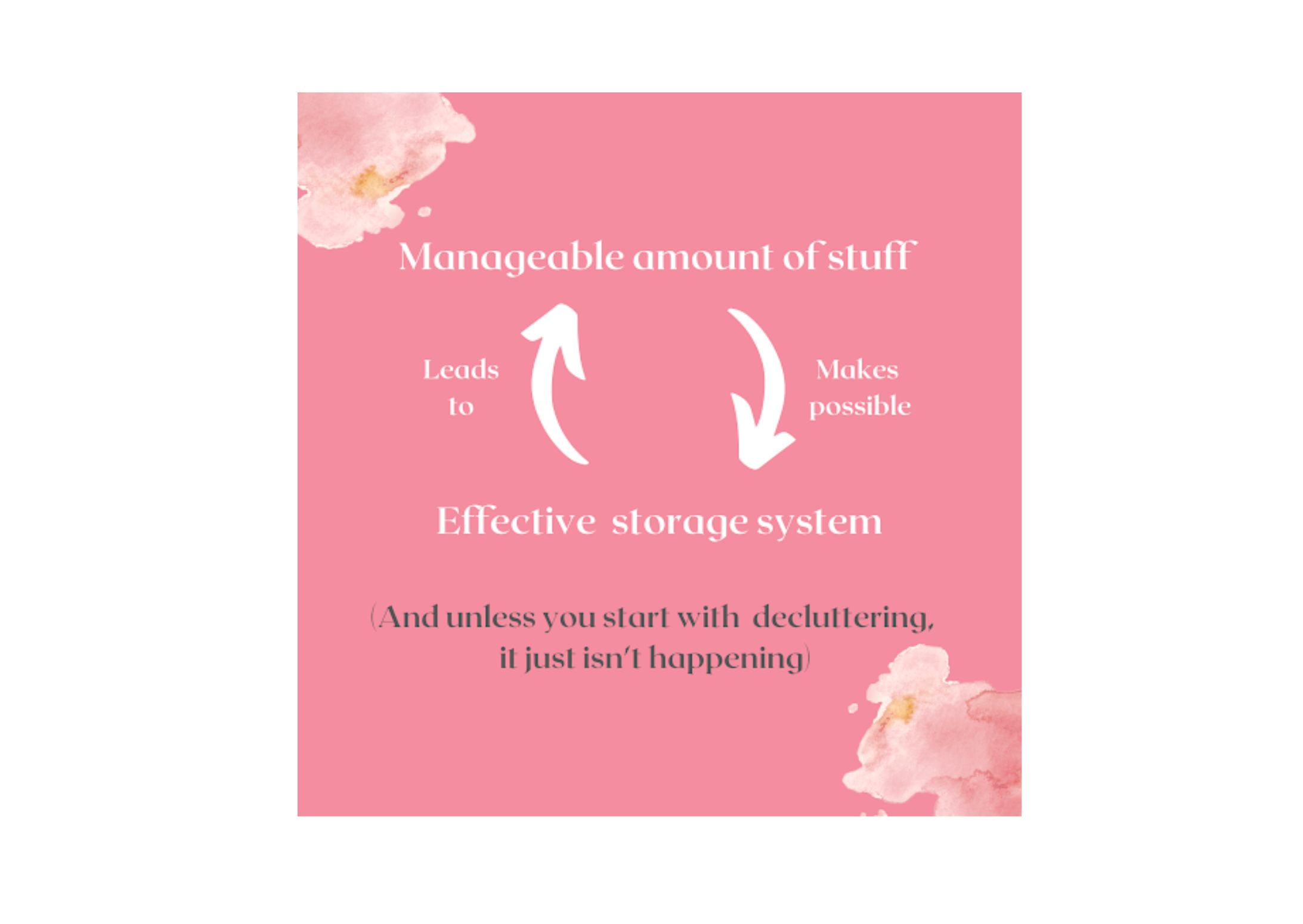
On the other hand, well-organized stuff will feel more manageable. In fact, it’s more than that. When your stuff is organized appropriately, two important things happen as a result.
- It’s easier to put things away in their correct places than not to. The items that are out of place in your otherwise tidy space will pull at you to get them into their homes. The effort of putting an item away into the spot that you already know it belongs in, that you don’t have to fight through other stuff to get to, or push other things aside to make space for the item, will feel quick, smooth, and automatic. Whereas an item sitting out of place will annoy you, to the point where that annoyance is much greater than any annoyance associated with putting the item away.
- You are less likely to buy more stuff. That’s right. Your stuff, already at a manageable quantity, is likely to stay at a manageable quantity. Why is that? Well, you see, when your stuff is arranged right, not only is it easy to interact with it in terms of tidying it up, it’s also set up so that you can see it all, and can get your mind around it. You know what you have. When you know what you have, you’re much less likely to think you are lacking in something and be tempted to go out and buy it.
What you’ve suddenly got is Condition B—lower likelihood of buying stuff—encourages Condition A—the state where the amount of stuff that you have is manageable.
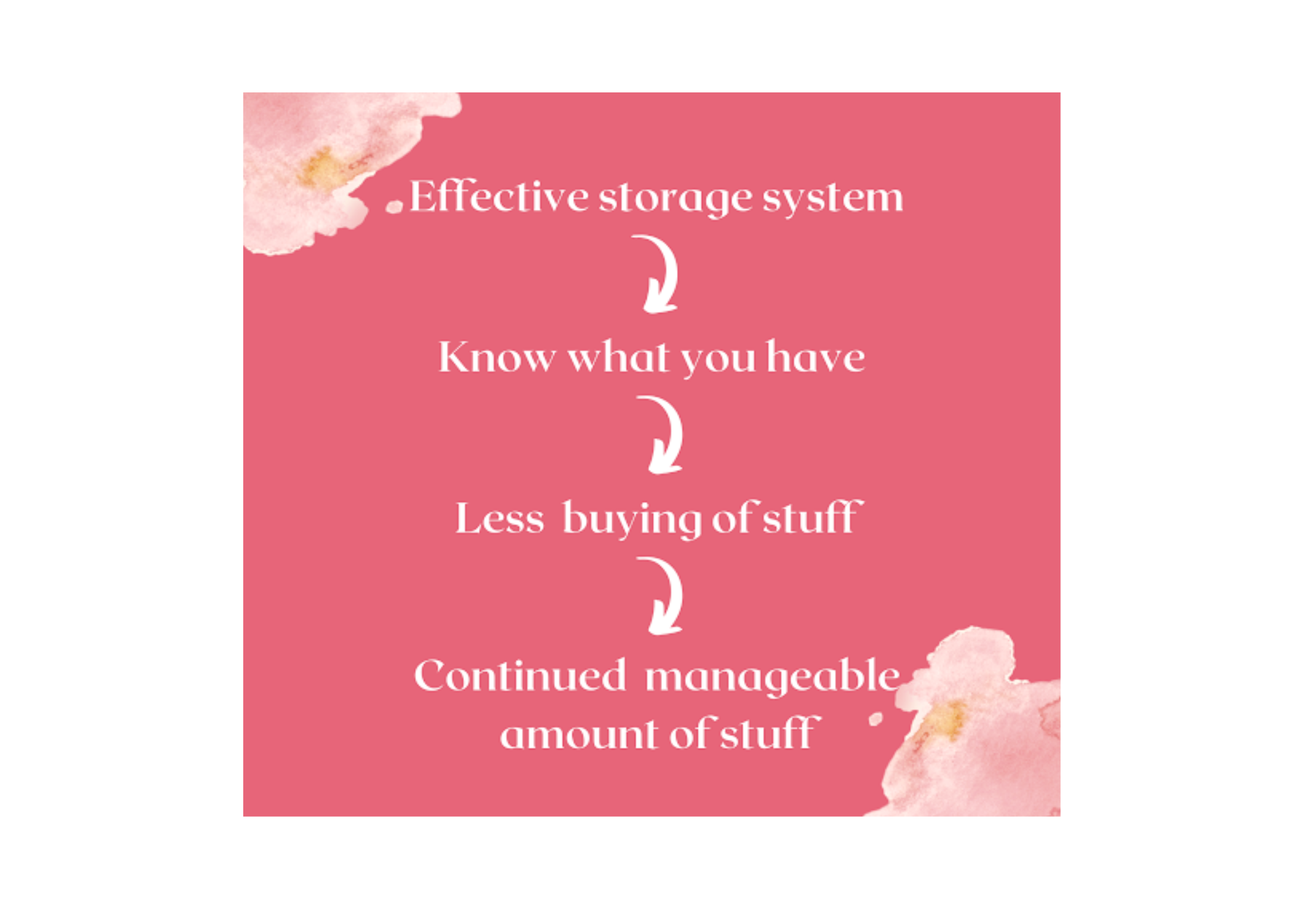
And there you have it. A nice virtuous loop, where you’ve got yourself down to a set of belongings that can be managed well, and a system for managing them that discourages you from constantly buying more. This is the closest thing I’ve come across to a “tidying world” version of a perpetual motion machine.
I think right here is where a lot of books on these topics are incomplete. Either they focus purely on decluttering, or purely on organizing. There is nothing inherently wrong with that, since it’s hard enough to produce coherent content on even one topic at a given time.
Marie Kondo is able to complete this cycle by covering both decluttering and organizing. But still, how does the KonMari method actually achieve those aims? Discussing both decluttering and tidying is a necessary component of getting us there, but it’s not sufficient, in itself, to get us there. What is it about the decluttering directions that makes them successful? What is it about the storage methods that makes tidying easier and shopping less attractive?
In the next section, I will go into more detail about how the various aspects of the KonMari method achieve these aims. Hopefully, by the end, you’ll see how each of those pieces is important to the method’s success.
Part 2: What Does the KonMari Method Involve and Why?
I’m going to take you through a set of twelve directives from Marie Kondo’s book, “The Life-Changing Magic of Tidying Up”. The thing to note is: Don’t expect to go to her book and find a chapter for each of these directives, or anything even close to it. Kondo’s book is not an engineering textbook. The mechanics of why the pieces work together the way they do is not what seems to be driving the structure of her book. The book is about how to apply her method. It also discusses why to apply it; namely, it presents an inspiring picture of how much better life is after tidying up her way. But what’s going on under the surface of how all the pieces come together to create the magic in the first place? That’s what we’ll talk about.
Part 2.1: Decluttering
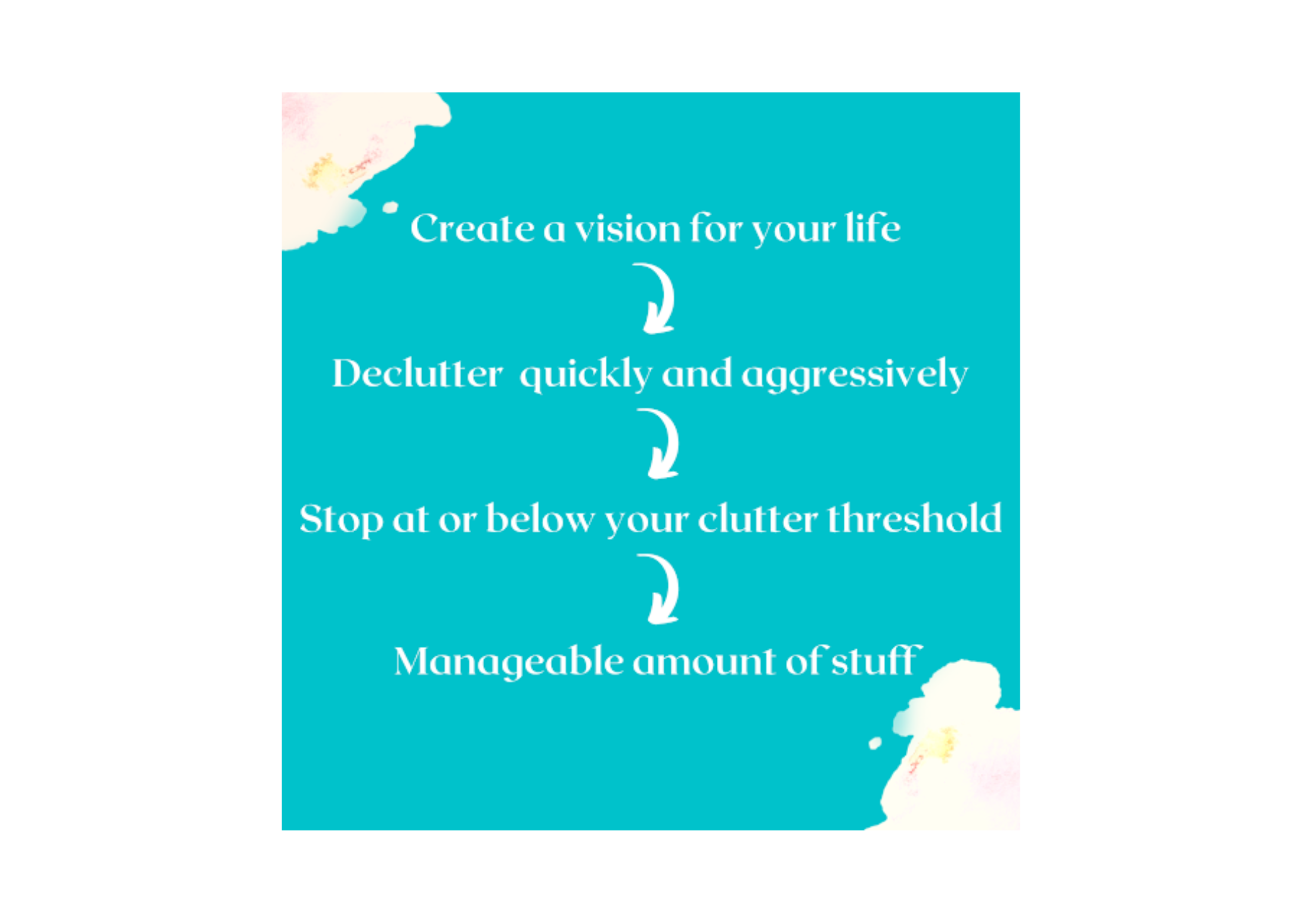
Directive 1: Visualize what you wish your life to look like
This idea is mentioned multiple times throughout the book, but without a chapter specifically dedicated to it, I don’t wonder that people don’t generally make a big deal of this one. But this is where you need to start. Yes, really.

I like Peter Walsh’s elaboration of this. His book, It’s All Too Much: An Easy Plan for Living a Richer Life with Less Stuff, was my first introduction to decluttering. He directs the reader to imagine their ideal life. Where they live, who they live with. Do their parents live next door or at the other end of the country? What kind of activities do they like to do? The more vivid your imagining (especially your daily movements through an uncluttered space where items are easy to find), the better.
It is amazing how much quicker the sorting goes when you know what you’d like your life to be like. I could easily tell from that point, for every item, whether it fit that life or not. In the end, getting sorting to be an efficient process is about getting your brain into a place where you can be decisive about what stuff really fits into your life. And planning that life gets your mind into that place.
Unless your life is exactly the way you want it to be, or you’ve thought about your ideal life a lot, you will not have a clear notion of what items make sense to keep or discard. You’ll wander aimlessly through your stuff thinking maybe you need the item in some way or other, and the “maybe” could very well be enough that you decide to keep that item—and thousands of others. In my upcoming book, I discuss how many items you need to go through when you’re decluttering and how much time the decluttering would be expected to take. The short story on that is: it’s not enough to hope for an efficient setup once you’ve finished tidying up. You need an efficient way of getting there. Your vision for an ideal life acts as your compass. You will meander and get sidetracked without it.
Directive 2: Focus on your own stuff
Marie Kondo makes it very clear that you should not interfere with other people’s stuff, or discard items on their behalf. I agree. It sounds quite considerate, right?
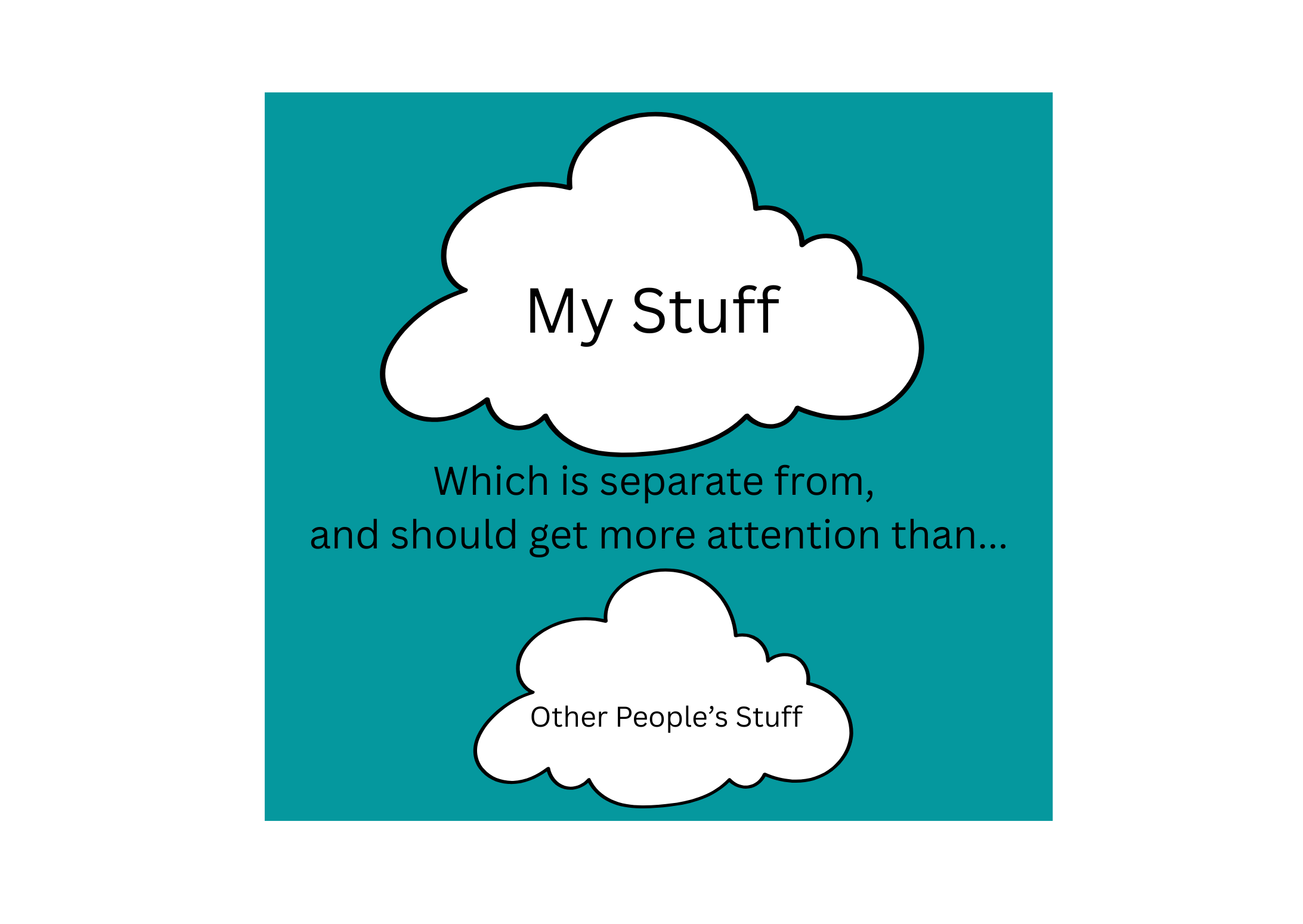
But there’s a self-interested side to that. For your own sanity, you need to expend most of your energy on your stuff, and getting it sorted to your satisfaction. No matter how tidy you get everybody else’s stuff, if yours is in a mess, you will feel overwhelmed, disorganized, and tired.
The media has recently hyped up the fact that Marie Kondo has failed to keep her home perfectly tidy now that she has kids. Maybe the entire world somehow thinks that Marie Kondo totally had a shock over this discovery. I have my doubts that she herself was surprised by that. Her book talks about the fact that you can’t get other people’s mess under control. She goes so far as to suggest that if other people’s stuff annoys you, it’s your own stuff that’s truly giving you trouble. I’m not entirely sure I agree. Other people’s mess in the home’s common areas bother me no matter how nicely tidied my things are.
But the fact remains: you don’t get to control other people’s actions, or their stuff. You can corral it somewhat: close the kids’ bedroom doors, shove the clutter on the floor into a cupboard when expecting visitors, store your partner’s stuff in a separate dresser to yours (and don’t look inside it!). But if you try to truly get other people’s things in order; guess what, you’ll never get them in order. They’ll just keep messing it up to their satisfaction, and you’ll never feel “done”. So to get to a point where you feel in control of your stuff, it is absolutely necessary to focus on the stuff that you can control; yes, the stuff that’s yours. (If you’re the person who rules the kitchen or laundry, you have my permission to call that stuff yours and make unilateral decisions about it).
Directive 3: Sort by category, not location
Do you keep clothes or pens or books in more than one location? Consolidate a category of items before you sort it. Otherwise, your thoughts will be scattered just like your possessions; you won’t know what you’ve got. Do not sort your bedroom drawer by drawer, or your home room by room. Gather a category of items into one place before you start sorting them. Sort your shirts together, your shoes together, your Post-it note supply together. Don’t interrupt your shirt sorting to ask yourself questions about shoes, or vice versa.
Directive 4: Sort the easier categories first
For most people, clothes will be easier to sort than sentimental items like photographs. Marie Kondo has a very specific order in which to sort: clothes, books, papers, miscellaneous, and finally sentimental items. (Note at this point that, in this scheme, the miscellaneous category includes everything from shampoo to forks to holiday decorations, and you really do need to then sort more finely by type of item). I am on the fence about how important that exact order is for everyone. But if you want to progress through the decluttering process in an efficient way, then absolutely avoid starting with anything sentimental and start with items where decisions will be easier. This will help you build up your “decluttering muscles”, as well as creating the momentum to keep going once you’ve started.
Directive 5: Keep only the items that spark joy
We come to the most famous KonMari directive of them all: Only keep the things that spark joy.
Peter Walsh, just like Marie Kondo, has only one sorting criterion. He asks, “Does this item fit in with my ideal life?” (I’m paraphrasing a little). It is very similar to Marie Kondo’s criterion of sparking joy. You may get tripped up on the occasional item. It might be the medicine that is critical for your medical condition; it doesn’t fit with the life you want, since you wish you didn’t need it. It might be the one frying pan you own that you can’t afford to replace with a nicer one just yet; it doesn’t spark joy for you when you pick it up. Don’t worry, you’ll be aware enough to know that yes, that gets kept.
Having only one sorting criterion to consult when you are decluttering speeds up the process immensely. How many times have you tried to declutter and found the process laborious and time-consuming? Having a criterion that makes the process quick and easy increases your chances of actually completing it. And the criterion of sparking joy is not random at all, it does actually, under the hood, take into account how useful your items are. If you like something, chances are you’re using it more often than items you don’t like.
As well as speeding up the decluttering process, this criterion is an aggressive one. The items that you truly love, that fit in with your ideal life, are likely to be a minority of the items you have. Sorting this way will get you down to a small number of items, a number of items that you can truly manage.
Directive 6: Reduce until you reach the point where something clicks
This might sound vague; until you try it. Do you wonder why Marie Kondo never tells you where that point is? It’s not just because she’s a nice person who wants to give you the freedom to decide for yourself. It’s also something she literally does not have the answer for you specifically. Let me explain.
Have you seen how some of your friends have a lot of more stuff than you do, but can keep it tidy? And how some of your friends have less stuff than you do, but it is still more messy than your stuff is? This is where you see the concept that Dana White, author of How to Manage Your Home Without Losing Your Mind, calls the Clutter Threshold. Your clutter threshold is the point at which your stuff becomes too much for your brain to manage. Above that threshold, your stuff will tend to untidiness and chaos very, very quickly. My own clutter threshold is very low. I recall a relative being shocked at how empty my fridge was. She seemed to think we were on the verge of starvation. In fact, I had just done the weekly grocery shopping the previous day. And yes, we lasted out till the next shopping day just fine.
Storage tricks can help you keep things tidy. But they will not increase your clutter threshold from one thousand items to ten thousand. There is only so much you can do with your stuff if you have so much of it that you can’t get your mind around it. You can sort things into categories and store them in nice boxes and label the boxes all you want, but after a certain point, there will still be too much stuff for your brain to keep sorted. You’ll know, internally, that you have better things to do than to think about your stuff, and your mind will conk out on you, or at least turn to other more important or more interesting things.
When you discard items, you will clear up space in your mind. And that’s where that something will click. When you get your stuff decluttered to the point where it is below your clutter threshold, you will feel it. Because at that point, your brain will, for the first time ever, be able to construct an understanding of what stuff you actually have.
Comments
You can see how if you don’t have a vision for where to end up, or an efficient way to get there, you’ll likely be stalled in decluttering down to a manageable amount of stuff. But if you have those things in place, and persist until you get below your clutter threshold, you will get to a place where the stuff you have can be managed effectively.
Part 2.2: Storage
Directives 7–12 have a similar theme: what should go together, and what shouldn’t? Let’s discuss this further.
Directive 7: Store items by person
Your stuff has to be stored separately from other people’s. If there isn’t a boundary between your stuff and other people’s, their stuff will mess up your stuff and make it harder to manage your stuff.
This is why there are doors to my kids’ bedrooms, doors behind which I can conveniently shove stuff that is creeping into common areas and annoying me. This is why my husband has his side of the wardrobe and I have mine.
It is for this reason that I never had a “mom” purse. You know, those large bags that let you carry not only your wallet, but the kid’s diapers, snacks, changes of clothes, and maybe even the baby herself. Instead, we had the “baby bag”: the bag that always went where the baby went, carried by whichever parent had the kid at the time.
Directive 8: Store the same types of items in one place
Storing the same type of items in one place refers to items that are similar to each other or are used together. Most of us automatically keep clothes in one place and knitting supplies with other knitting supplies. We might forget to keep paper and scissors together with pens and pencils. If you don’t keep related items together, they will be hard to find. You’ll have to use more memory to remember where it’s kept. It won’t be easy to put away because things that are used together aren’t to be put in the same place. You’ll end up putting things away in “incorrect” places and having a harder time finding them next time.
Directive 9: Don’t scatter storage
This directive is a finer distinction on keeping the same types of items together. But it is sufficiently important that it deserves to be mentioned separately. It means if you have lots of pens, you keep them in one place. You don’t have two storage places for spare soap. You don’t designate five different places in the house to store five distinct pairs of scissors.
This is more important than you think. It might seem to make sense to store five pairs of scissors in five different parts of the house. That way, theoretically, you always have one nearby. It doesn’t work that way. I promise you that every time you go to location one to find the scissors, you will find that they have all migrated to location five, and vice versa. Wherever you are when you want the item, it will always be somewhere else.
What will you do then? Maybe you’ll go and buy more pairs of scissors. If you can’t find the item when you need it you might think you need more of them. And then, of course, you do the same for all your other items. Pens, food storage containers, nail clippers, you name it. Sadly, this doesn’t work. Because now, when you need a pair of scissors, all you’ll be able to find is lots of pens, and when you need pens, all you will be able to find is lots of pairs of scissors.
If you keep items of the same type in different places, your brain, knowing that it has better things to do, will not remember those multiple places. You are pretty much guaranteed to be overstocked on stuff and never be able to find it when you need it. Yes, that is a double insult, and one that can be avoided.
Directive 10: Store items where they’re easy to put away, rather than where they’re easy to get out
To be honest, if it’s easy to put away, can it really be that hard to get out? But stay with me here.
As far as I know, nobody other than Marie Kondo has talked about this, and in my opinion, it’s one of the more important things she has to say. If an item is not easy to put away—guess what?—it won’t get put away! You don’t think that’s profound? Based on how often I see this violated, it doesn’t seem to be that obvious. But as it is, if tidying up resembles a game of Tetris, it’s not likely to happen very often.
Directive 11: Designate a spot for every last item
It’s bad enough when you don’t know where an item is. But if you don’t know where the item goes, and you have a busy day—or rather, a busy life—you are not going to spend those extra seconds thinking about where to put the item. It will get crammed in somewhere, adding to the clutter and making it hard to find again.
Now, consider for a moment. If you were to go and tidy up all the things that are out of place in your home right now, how many of them would have a home that you could directly place that item into without giving the matter any thought whatsoever? Would you know the precise drawer in the precise room to put it in? Or would your process be hampered by only vaguely knowing what type of item it was, and having to create a storage place for it, right at that moment? How much of your tidying is taken up by having to figure out where to put items, rather than just putting them in a place?
When you know where each item goes, putting items away takes a small fraction of the time it otherwise would. You aren’t thinking; you aren’t tiring yourself out making the same decisions over and over regarding where to put this stuff. It just happens.
Are you thinking you don’t have the time to designate a spot for each item? If you have too much stuff, then no, you don’t have the time, and you don’t have the energy. That’s where Condition A feeds into Condition B. Managing your stuff effectively requires you to get down to a manageable amount of stuff.
Directive 12: Use vertical storage rather than piling things
The famous Marie Kondo clothes-folding is an example of this. When you look down at the folded items, nothing is underneath anything else. Your clothes are stored like they are in a filing cabinet. You can see everything when you look from the top. You know what you have. No scrabbling around finding what else there might be. And as a bonus, you are using all the vertical space in your drawer, so that you can fit more things in.
To be honest, this is the directive I found the most confusing. What does vertical mean anyway? After pondering it for a bit, my conclusion is as follows: It’s about being able to see what you have, and access what you have, without having to move other things out of the way. When you open a drawer or a cupboard, or stare at a shelf, you should know what items you have there just by looking, not by having to reach in to get behind or under anything. So when in doubt, don’t worry about the idea of vertical or wonder what was meant by that. Ask yourself whether you can easily see what you’ve got and access it without shifting things around.
Comments:
Notice that Directives 8 through 12 all serve a certain purpose. They either:
- Make it easy to put things away where they belong. (This leads to tidying being easier than not tidying, and the feeling of a house that keeps itself tidy). Or…
- Make it easy to see what things you have so that you aren’t as tempted to buy things you don’t need. (This makes it more likely that your stuff will stay at a reasonably steady state, so that you don’t have to keep decluttering over and over). Or…
- Both.
I’ll give you one bonus directive from Marie Kondo. Of course, she wrote a whole book, there’s a lot I could talk about; But I’ve picked out what I think are the critical elements that make the method work the way it does, and I will leave you with just one more item.
(Bonus) Directive 13: Tidy in one go
Reflect again on what I said earlier: a tidy home happens when items are easier to put away than to leave out. In its most basic form, how does this work? It happens with the following scenario:
There is only one item left out. Everything is in its place, and you are putting away that one thing. Putting that one thing away is easy to do; you know where it goes and the place is within easy reach. Once that thing is put away, your home is back to a perfectly tidy state.
Under these conditions, you will be literally pulled towards putting that one item away, so as to complete that state of everything being in its place and looking wonderfully tidy!
Is that how it goes in real life? Probably not. If two items are out of place, you have an extra item standing between you and that “one item left out” state that I described. And so on the more items are out of place.
But the closer you are to the state of at most one item being out of place, the easier it is to get back to a tidy state. I suspect this is why Marie Kondo says to tidy in one go. If your home is only halfway towards getting tidied up, you might not have a critical mass of tidiness to be motivated to put things away. It’s also unlikely you’ll have things organized in a way that lets you know what items you’ve got so that you don’t go buying any more.
Of course, tidying up your entire house in one go is difficult to do. It likely can’t be done in just a day. (In fact, Marie Kondo estimates it takes about six months.) So it’s a tricky directive to actually implement. But I do think it makes a really important point. Namely, to access the full power of the method, you need to implement it in its entirety.
Conclusion
So there we are. We’ve been given a system for keeping our stuff under control, so that we can spend time on the things we actually want to do!
If you liked this article, you may also enjoy my book: Productivity For Women: How to Find Time For the Important Things When You Don’t Have a Wife to Do Everything Else.
